
Happy New Year from I-80 Forklift


| Rise above risk. Realize possibilities. | |
| It's time to look at the job differently. You need new ways to reduce risks to your workers and your bottom line. Your team needs smarter, faster ways to get work done at height. With the enhanced line of low-level access lifts from JLG, you're equipped to minimize cost, boost productivity and power a better outlook for your business. | |
|


You may have heard the words “circular economy” mentioned recently and wondered why?
It’s a phrase being used in the equipment industry right now to promote the idea of manufacturing or producing machinery in a sustainable or environmentally friendly way.
Equipment reconditioning programs are not new to the industry. In fact, JLG launched its program more than 25 years ago. Yet, there still is a lot of confusion about what it is, and what it is not.
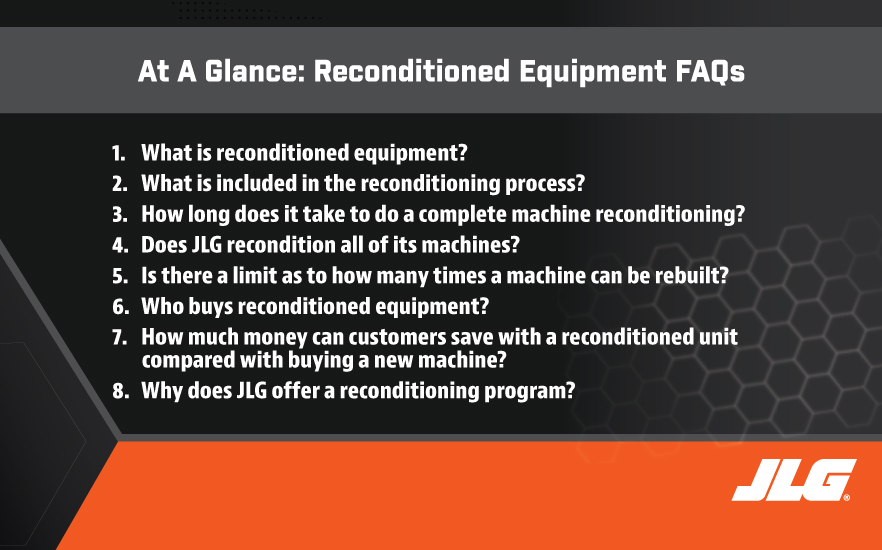
Let’s take a look at eight frequently asked questions about reconditioned equipment and how JLG’s program benefits the circular economy...
1. What is reconditioned equipment?
To best understand what reconditioned equipment is, it’s important to understand exactly what reconditioning entails. And, that definition differs among OEMs. For some, reconditioning is simply putting new paint and tires on a machine.
For others, including JLG, reconditioning programs follow strict guidelines to rebuild machines to like-new condition.
2. What is included in the reconditioning process?
The JLG reconditioning program is designed to adhere to the same guidelines as new equipment manufacturing. It is more than just a paint job because repairing and restoring reconditioned machines to their original specifications must be a complete process to give them new life, inside and out.
To bring back JLG equipment to the initial machine specifications of the model from its original manufacture date, our extensive reconditioning process includes:
Once a machine is returned to “like new” condition through the reconditioning process, JLG requires that it be able to pass the required ANSI annual machine inspection, which includes a thorough evaluation of four major components (as applicable by model): 1) Electrical system, 2) Hydraulic system, 3) Drive train and 4) Structural components, as well as meet other applicable ANSI standards. All of JLG’s reconditioned machines come with a standard 3-yr warranty. This commitment to detail ensures that JLG reconditioned units are ready to go straight from the facility to the job site.
3. How long does it take to do a complete machine reconditioning?
JLG’s reconditioning process and facility are extremely efficient, and a machine can usually be reconditioned in 2-3 weeks. The exact amount of time to recondition a machine depends on the machine itself. Factors that influence this include its size, the condition of the machine and the availability of parts needed to return the equipment to the original specifications of its manufacture date.
4. Does JLG recondition all of its machines?
JLG’s program is currently available on 40 ft and above IC (internal combustion) boom lifts.
5. Is there a limit as to how many times a machine can be rebuilt?
There is no limit to how many times a machine can be reconditioned. That said, over time a machine’s technology and components will become outdated, even obsolete, and at that point, either JLG or our customers may decide that it is no longer feasible to continue to invest in reconditioning the machine.
6. Who buys reconditioned equipment?
Customers who purchase JLG reconditioned machines are often looking to grow and manage their fleets with lower-cost equipment investments in higher-quality, higher-value products.
7. How much money can customers save with a reconditioned unit compared with buying a new machine?
Cost savings vary by machine, but it is estimated that a reconditioned machine offers 25-35% cost savings over purchasing new.
8. Why does JLG offer a reconditioning program?
From new production through reconditioning, JLG is able to deliver the whole spectrum of equipment, helping customers expand their fleets to include the products they want and need — meeting their business goals in every way possible.
Since its launch in 1997, JLG’s reconditioning program has grown through all economic conditions, regardless of the market conditions (supply chain constraints, looming recession, etc). The JLG reconditioning program, in addition to helping the circular economy by giving second life to JLG machines, is about flexibility. It offers customers many options to create the right fleet mix to meet their specific business needs, particularly in fluctuating market conditions.
Simply put: It gives customers the opportunity to invest in high-quality reconditioned, like-new JLG stock machines for less than the cost of a new equipment purchase.
Interested in learning more about how JLG factory-trained experts restore its machines to like-new condition to offer help the environment and offer customers a great alternative to buying new? Get more details about the program by clicking here.
Do you want to stay up-to-date with industry news and issues similar to this? Make sure you subscribe below to receive monthly updates from #DirectAccess with newly posted content so you never miss important information.


In Loving Memory
of our FRIEND Craig Ringler
1/18/1985 – 10/12/2025


